
Enterprise IT Architecture at Vontobel
Published on 04.09.2026 CEST
At its core, investment management is an information business. Every investment decision, payment, trade, booking, client interaction, and regulatory report depends on technology working seamlessly in the background. This creates a highly interconnected and increasingly complex IT landscape that must remain secure, reliable, and adaptable.
Enterprise IT Architecture acts as a guiding light within this complexity. It helps us understand where we are today, where we want to be tomorrow, and how many elements of our technology landscape need to evolve together. By providing a common reference point across business and technology, Enterprise Architecture supports better decision-making, more effective investment decisions, and a coordinated transformation towards a more data-driven and AI-enabled future.
This translates into tangible benefits: faster delivery of new capabilities, better experiences for clients and employees, lower operational risk, greater scalability, and more effective use of data.
Today, that journey is increasingly shaped by two strategic themes: the modernization of our technology landscape and the growing importance of data as the foundation for analytics, AI, and future productivity gains.
Architecture as an Enabler of Transformation
Enterprise Architecture connects business strategy, technology investments, and transformation initiatives. It provides a holistic view of how capabilities, applications, data, teams, and platforms fit together, and how changes in one area impact the broader organization.
This becomes particularly important during periods of transformation. Every initiative competes for funding, resources, and attention. Enterprise Architecture provides the framework to evaluate priorities, identify dependencies, and ensure that investments contribute to a coherent long-term vision rather than a collection of disconnected projects.
At Vontobel, we deliberately keep this approach lean and pragmatic. Our guiding principle is: “As simple as possible, but not simpler.” Enterprise Architecture is not a documentation exercise. It is a practical management discipline that helps align business and technology, create transparency, uncover dependencies, and support informed investment decisions. The goal is to make the most important relationships visible so that change can be delivered in a coordinated, efficient, and purposeful way.
How Our Technology Capabilities Work Together
Vontobel’s Enterprise IT Architecture can be viewed as a set of interconnected technology capabilities. Together, they enable a continuous flow from the execution of business processes, through the creation and management of data, to the generation of insights and, increasingly, the delivery of AI-enabled solutions.
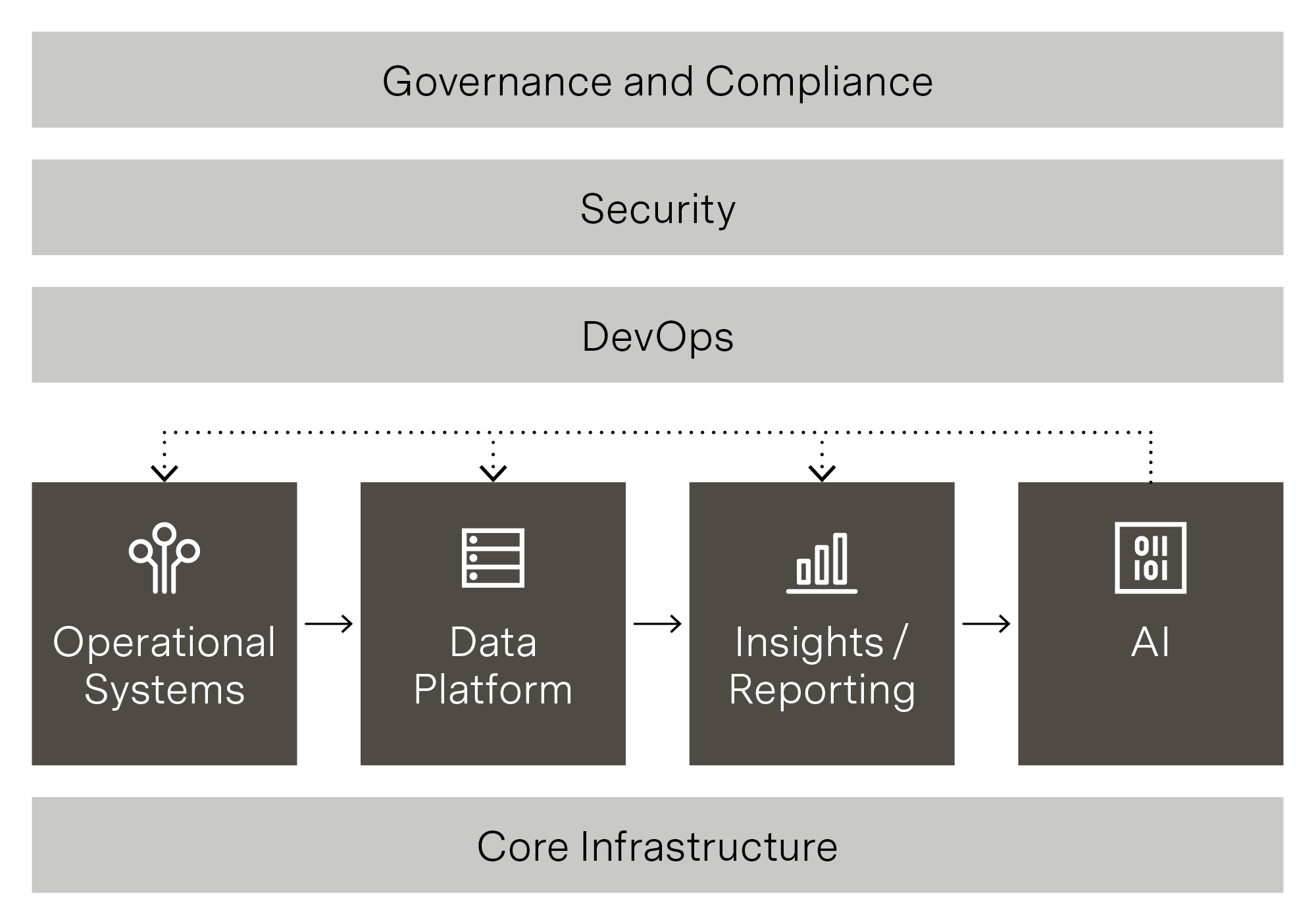
Operations create information. Operational systems support the day-to-day processes through which we serve clients and manage our business. These include platforms for core banking, client relationship management, accounting, and other essential business functions. They are where transactions are executed and where much of Vontobel’s information is created.
The Data Platform turns information into a trusted and reusable asset. It integrates, stores, governs, and distributes data across Vontobel, creating a consistent foundation for reporting, analytics, regulatory requirements, and future AI-enabled solutions.
Data becomes valuable when it drives action. Reporting and analytics provide the insights needed to monitor performance, identify opportunities, ensure compliance, and support better decision-making.
Artificial intelligence extends how information can be used. Building on trusted data and business context, AI capabilities can support employees, increase productivity, accelerate the development of new solutions, and generate more relevant insights.
Our technology capabilities depend on a modern and resilient technology foundation, including workplace services, infrastructure, and cloud platforms.
Engineering and DevOps enable reliable delivery. They help us develop, test, deploy, and operate solutions efficiently, securely, and at scale.
Security, Governance, and Compliance provide trust by design. They apply across the entire architecture, ensuring that technology, data, and processes remain secure, controlled, and trustworthy.
Our Transformation Journey: Building Technology Capabilities that Create Business Value
Vontobel’s Enterprise IT Architecture is evolving rapidly. Clients, regulators, and internal stakeholders expect greater agility, transparency, and innovation, while data and AI continue to transform the delivery of financial services. At the same time, core platforms must remain secure, reliable, and operationally efficient to support the business at scale.
Continuous modernization is therefore essential. Without it, complexity and operating costs increase, change becomes more difficult to implement, and the ability to benefit from emerging technologies is constrained. Enterprise Architecture helps us address these challenges by coordinating investments, managing dependencies, and ensuring that individual efforts contribute to a coherent long-term direction.
The following examples highlight some of the most important transformation initiatives currently underway across Vontobel. Enterprise Architecture provides the connective tissue between these initiatives, ensuring they reinforce one another rather than evolve in isolation. It makes dependencies visible, promotes reuse, and guides investment towards shared capabilities instead of standalone solutions. In doing so, it creates tangible business value through more efficient delivery, lower complexity and operational risk, better support for employees, and a stronger foundation for serving clients and driving future innovation.
A modern digital foundation enables employees to work effectively and allows technology capabilities to scale securely and efficiently. Our Digital Workplace Modernization programme is transitioning employees from virtual desktop environments to corporate laptops and modern collaboration services. The goal is to enhance the user experience, increase productivity, and provide a flexible foundation for future ways of working.
At the same time, our Move to Cloud programme is progressively migrating suitable platforms and applications to cloud-based environments where this delivers clear business value. This provides access to scalable and flexible technology capabilities, accelerates the implementation of change, and reduces the limitations associated with ageing infrastructure.
We are also modernizing Identity and Access Management (IAM). The objective is straightforward: ensuring that the right people have access to the right systems and data at the right time. More consistent, automated access controls strengthen security and compliance while reducing manual effort and operational risk.
Together, these initiatives create a more resilient, secure, and future-ready technology foundation that supports Vontobel’s broader transformation agenda.
As part of the transformation of our Private Clients IT landscape, we are introducing Salesforce as our Client Lifecycle Management platform and establishing an integrated core banking architecture across Vontobel’s booking centers. Together, these initiatives enable a more consistent and seamless client experience, support the harmonization of products and services, and increase efficiency through greater standardization and reuse across the organization.
The New Finance Platform programme is modernizing our finance landscape through the introduction of the cloud-based SAP S/4HANA platform. A more integrated and modern finance environment improves the availability and consistency of information, strengthens end-to-end processes, and supports more informed management decisions.
The impact of these initiatives extends beyond technology. Modern platforms and standardized processes reduce complexity, strengthen operational resilience, and increase the organization’s ability to adapt to future business, regulatory, and technological change. They provide a scalable foundation that supports growth, innovation, and long-term competitiveness.
Artificial intelligence is a strategic focus for Vontobel. We are therefore building the infrastructure, governance, and technology capabilities required to deploy AI securely, consistently, and at scale across the organization.
Our AI architecture is designed to provide an agent-centric infrastructure in which AI capabilities can be developed, governed, and integrated into business processes in a controlled manner. Rather than creating isolated solutions, our objective is to establish reusable capabilities that can be leveraged across business domains and functions.
In the near term, AI will enhance existing activities such as software development, information retrieval, reporting, and document preparation. Over time, we expect AI capabilities to become increasingly embedded in everyday work, helping employees access information more efficiently, automate routine tasks, support decision-making, and interact seamlessly with systems and data within clearly defined security and governance boundaries.
The objective is to create a scalable foundation for a new generation of digital capabilities. By combining trusted data, modern platforms, and responsible governance, AI can increase productivity, improve service quality, accelerate innovation, and help Vontobel create sustainable business value in the years ahead.
The Data Platform: Turning Data into Value with Data Products
Among the capabilities within our Enterprise IT Architecture, the Data Platform has become particularly important because trusted and accessible data enables tangible business outcomes. It supports better client insights, more efficient and reliable reporting, stronger data-driven decision-making, and the responsible use of AI.
At Vontobel, we treat data as a strategic asset and a key enabler of our transformation towards a more digital and client-centric organization. Our ambition is to turn data into trusted, reusable, and business-ready products that create measurable value. This is becoming increasingly important as data volumes grow and technologies such as cloud computing, advanced analytics, and generative AI reshape the financial industry.
Our approach is inspired by Data Mesh principles. In practical terms, this means treating data not as a technical by-product of individual systems, but as a reusable business asset with clear ownership, defined quality standards, documentation, and lifecycle management. Business domains are responsible for their data products end-to-end, from creation and quality assurance to publication and ongoing maintenance.
The technological foundation is a scalable, cloud-based Data Platform. It supports the full data lifecycle, from ingestion and transformation to storage and consumption. Through data-sharing capabilities, information can be exchanged with critical operational systems like our Core Banking, CRM or Accounting applications without unnecessary data duplication. The Data Platform is complemented by an Integration Platform that connects operational systems through APIs, streaming technologies, and file-based interfaces. Together, these capabilities provide a modern foundation for reporting, analytics, and future AI-enabled solutions.
However, a successful Data Platform is about more than technology. It also requires governance, trust, and usability. In a regulated environment, data must be secure, compliant, and auditable, with clear lineage and adherence to legal requirements. Equally important, users must be able to discover, understand, and confidently use available data. A data marketplace enriched with metadata such as ownership, lineage, quality indicators, and usage guidelines helps increase transparency, reduce duplication, and promote reuse across the organization.
To scale this model successfully, standardization and adoption are essential. Clear guidelines, taxonomies, and best practices create consistency across domains while allowing flexibility for specific business needs. Just as importantly, building a modern Data Platform requires a cultural shift from viewing data as something stored in systems to recognizing it as a product that creates business value. Training, documentation, and user enablement are therefore integral to our journey.
Ultimately, the modern Data Platform combines decentralized ownership, strong governance, scalable technology, and a product mindset. It enables Vontobel to unlock the full value of its data through better reporting, improved decision-making, enhanced client experiences, and a stronger foundation for future innovation and AI adoption.
«At Vontobel, we treat data as a strategic asset and a key enabler of our transformation towards a more digital and client-centric organization.»
Why Data Becomes Even More Important in the AI Era
As AI and agent-based systems evolve, they can only be as useful and reliable as the data and business context available to them. If data is fragmented, poorly documented, or difficult to access, the value of AI remains limited. If data is trusted, reusable, discoverable, and governed, AI can become a powerful productivity accelerator.
This is why data and AI should not be viewed as separate topics. The AI platform provides the enterprise-ready capabilities required to develop and deploy AI solutions in a secure, scalable, and controlled manner. The Data Platform provides the trusted information foundation that enables those solutions to deliver meaningful business value.
In practice, the key question is no longer, “Which AI model should we use?” The more important question is: “Which trusted data and business context can an AI solution access, and under what controls?” This is where the Data Platform becomes strategic. It ensures that the information foundation for AI is managed as an enterprise capability rather than assembled ad hoc for individual use cases.
This is why our investments in data products, governance, discoverability, standardization, and adoption are so important. They improve reporting, analytics, and decision-making today and establish the foundation for secure, scalable, and productive AI adoption in the future.
Technology Transformation Enabled by a OneVontobel Culture
Modernizing an enterprise architecture is more than a technology challenge. The technologies themselves are often well understood. The greater challenge lies in coordinating change across business units, functions, processes, and teams while maintaining day-to-day operations.
This is where the OneVontobel culture becomes a critical success factor. Transforming a complex technology landscape requires close collaboration between business and technology teams, shared ownership of outcomes, and a willingness to continuously learn, adapt, and improve. No single team can deliver this transformation alone.
Many of the initiatives described in this article span multiple business areas and architectural domains. They require experts from different disciplines to work towards common goals while balancing short-term priorities with long-term strategic objectives. Such collaboration is only possible when there is trust, transparency, and a shared commitment to Vontobel’s success. Equally important, collaboration allows us to maximize the value of our investments by reusing capabilities across the organization rather than solving similar challenges multiple times.
A mindset of continuous change is just as important. In today’s environment, transformation is no longer driven by isolated programmes every few years. Technology, regulation, and client expectations continue to evolve, requiring organizations to adapt continuously. Change is no longer an exception to normal operations. It has become a fundamental part of how we remain relevant, competitive, and resilient.
Ultimately, people make transformation successful. Through collaboration, accountability, and a strong OneVontobel mindset, we can modernize our technology landscape while preserving the efficiency, entrepreneurial spirit, and client focus that have always been defining strengths of our organization.
Building the Foundation for the Future
Enterprise IT Architecture is about ensuring that Vontobel can continue to evolve in a coordinated, efficient, and purposeful way.
Enterprise Architecture provides the direction and structure for this journey. The destination is clear: a modern, secure, data-driven, and AI-ready technology landscape that enables Vontobel to adapt to change, accelerate innovation, and create sustainable value for clients, employees, and shareholders.
Contact us
Published on 04.09.2026 CEST
ABOUT THE AUTHORS
 Show more articles
Daniel Hasler
Head Architecture & Transformation
As Head of Architecture & Transformation at Vontobel, Daniel Hasler is responsible for shaping the bank’s architectural vision, establishing enterprise-wide standards, and leading strategic technology transformation initiatives.
 Show more articles
Mario Vontobel
Head Group IT Architecture & Transformation
As Head Group IT Architecture & Transformation at Vontobel, Mario Vontobel is responsible for advancing the bank's enterprise IT architecture, steering architecture governance and decision-making across the organization, and delivering strategic technology transformation initiatives.
 Show more articles
Christina Schack
Lead Data Architect
As Lead Data Architect at Vontobel, Christina Schack shapes the bank’s data architecture strategy and establishes enterprise-wide data standards. By connecting business objectives with data engineering and AI capabilities, she enables future-proof solutions that maximize the value of data across the organization.