Vontobel @ TradeTech 2026
Published on 29.04.2026 CEST
Perspectives and Key Takeaways from TradeTech Amsterdam 2026
TradeTech Amsterdam was more than a content-rich event – it was a relevant experience for our team. The exchange within the group and discussions with peers, vendors, and market participants significantly broadened our perspective and informed our view on the future of trading.
Transformation in trading keeps accelerating. In most cases, failure does not come from strategy – it comes from people not adapting. Communication is not a side-topic; it is a core leadership responsibility. Trading desks operate under increasing efficiency pressure. At the same time, 24-hour trading is more complex than often assumed and heavily perspective-dependent: institutional versus retail clients face different realities. Today, what makes the difference are data, consistent leadership, and decisions grounded in facts.
24/5 Trading – Extended Hours: Retail vs. Institutional
This topic dominated many conversations. We will explore it in more depth in a separate article based on client surveys, a dedicated working group, and the input gathered at TradeTech. Our aim is to derive structured and actionable conclusions. The key inputs based on the current state of knowledge are:
Facts
Arguments
HR, Skills, and the Future of the Trading Desk
Over the next three to five years, we expect continued growth of multi-asset desks. Automation will advance across workflows, driving efficiency and scalability. Best execution will evolve from a cost metric to a key performance driver. Advanced infrastructure will provide buy-side desks with greater control through improved dashboards and API connectivity.
A key learning: the argument “people don’t have time” is a false framing. The real challenge is structural. Learning requires scheduled time outside the trading floor. Participants suggested defining an off-floor learning format, which I think is a very valuable input.
The use of data scientists on trading desks sometimes failed not because of the profile, but because of execution. Typical reasons are missing workflow adjustments, confirmation of existing intuition, and lack of outcome of ownership. Large tech companies show a different path: fast learning curves, dedicated skill development, and internal mobility. This leads to higher churn, shorter value creation of windows, and structured knowledge transfer. As a result, the impact on quality over a given period becomes more important than pure loyalty to a single employer.
Challenges for the Buy-Side Trading Desk
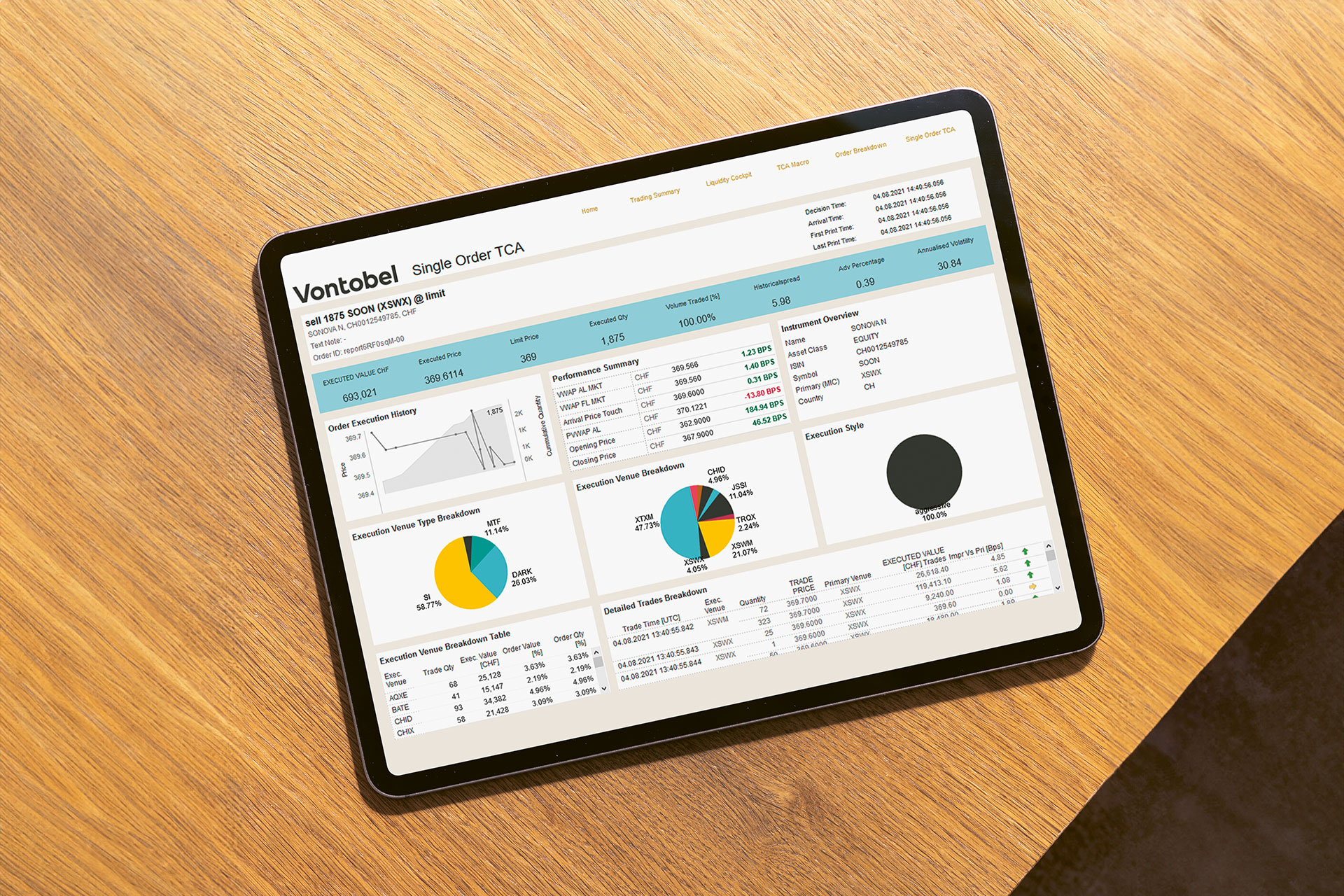
Value is created when trading becomes explainable: understandable reports, KPIs linked to outcomes, and transparent performance contribution. The trend is toward hybrid models that combine low-touch automation with high-touch expertise in timing, data interpretation, and trading cost analysis (TCA). At Vontobel, we apply exactly that through our mid-touch approach. Key value drivers are automation, scalability, cost reduction, and error reduction. Measurability gains importance, especially via TCA and proof of performance contribution. Advanced analytics becomes a differentiator; build vs buy remains a strategic decision.
Retail trading continues to shape the market structure. In the US, participation is far ahead of Europe. Smaller, more marketable retail flow creates liquidity during normal conditions but amplifies volatility under stress.
Multi-asset trading desks are emerging under efficiency pressure. Desks must deliver more output with fewer resources. Simply merging desks and asset classes without a clear target remains ineffective. Learning agility and adaptability will define competitiveness.
Technology remains in evolution, not revolution. New core systems or TCA providers are rarely focused. Instead, the depth of usage in existing partnerships is increased. Execution advantages come less from new software and more from consistent use of existing tools.

«Intelligent execution and meaningful interpretation of data create sustainable value. Too often, post-trade reporting is backward-looking and regulation-driven. The question that should guide us going forward is: “Could this order have been traded better?” Execution is becoming increasingly data-driven and more relevant. Trading desks justify their value through measurable contribution.»
Matthias Schiesser
Head Electronic Trading Solutions
AI, TCA & Data – The Real Edge
Across the panels, there was broad agreement: the analytical potential of TCA remains underused, despite its importance being widely acknowledged. For many brokers and clients, TCA remains in an early or exploratory stage, often limited by incomplete datasets and mainly used for reporting rather than guiding forward-looking execution.
Data availability has improved, but the leap from collection to robust, model-driven execution frameworks is far from complete. Today, TCA is mainly applied for ex post and primarily for best execution monitoring, only selectively to inform routing decisions or strategy selection.
Personal View
Those with stronger data foundations, robust models, and smart counterparty selection will lead. AI only creates value under strong governance; without clear controls, risk grows exponentially. AI in trading must not become an uncontrolled experiment. Best execution remains a duty, but it is now paired with performance measurement. Innovation emerges primarily in the US; Europe adapts.
True value today still lies in data quality and consistent application rather than framing TCA purely as an AI opportunity. Practically, this means trading desks need to strengthen their data foundations, define target operating models for multi-asset execution, and establish clear governance for AI-supported decision-making. Competitive advantage will increasingly come from: the ability to learn fast, manage data well, and measurable contribution to execution outcomes.
It all starts with a personal conversation
Published on 29.04.2026 CEST
ABOUT THE AUTHORS
Show more articlesMatthias Schiesser
Head of Distribution Electronic Trading Solutions
Matthias Schiesser heads the Electronic Trading Solutions department in the Transaction Banking unit at Vontobel. He is responsible for the distribution of Vontobel’s low-touch trading platform, custodian services, FX products and the Trading Analytics Platform™ (TAP). His three teams—Innovation Hub, Relationships and Salestrading—cover 150 institutional clients in Switzerland and abroad.